
The latest insurance claims data from New Zealand’s major health and life insurers tells a consistent story with orthopaedics topping the speciality list, imaging and tests dominating by volume, and claims paid out for members aged 65 and over running at roughly four times the amount paid for those in their late teens.
With long wait times for many common elective procedures and medical costs are outpacing general inflation by a wide margin, more people are turning to private insurance cover earlier in life. Here’s what’s behind these figures, and what’s worth considering about your own cover.
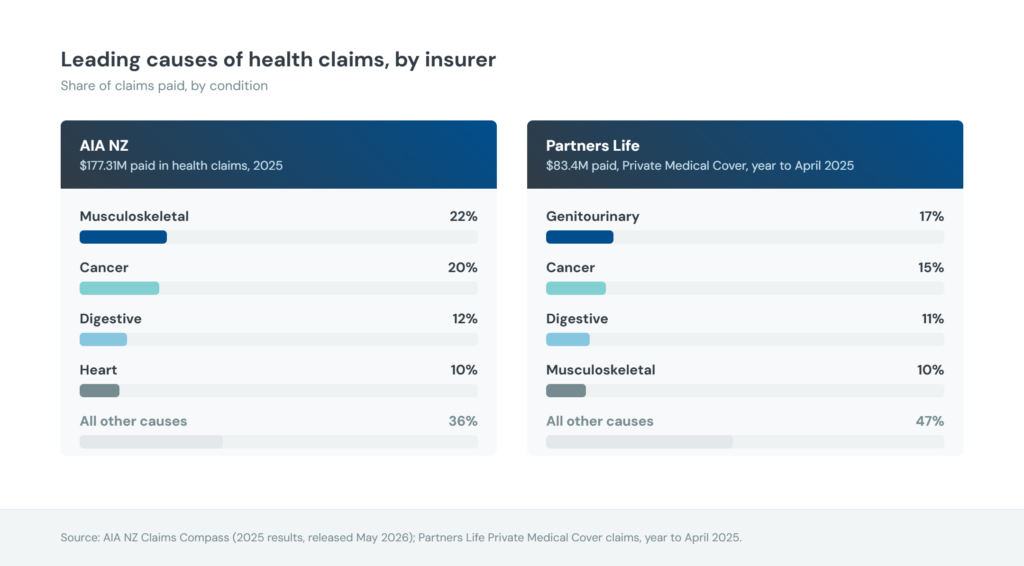
According to AIA NZ’s 2025 results, the company paid $177.31m in health claims in 2025 with musculoskeletal conditions being the leading cause of health claims paid (22%), ahead of cancer (20%), digestive conditions (12%), and heart claims (10%). Partners Life’s Private Medical Cover claims show a similar pattern, with the company paying out $83.4 million in the year to April 2025, with genitourinary (urinary and reproductive) conditions (17%) the leading cause of claims, followed by cancer (15%), digestive (11%) and musculoskeletal conditions (10%).
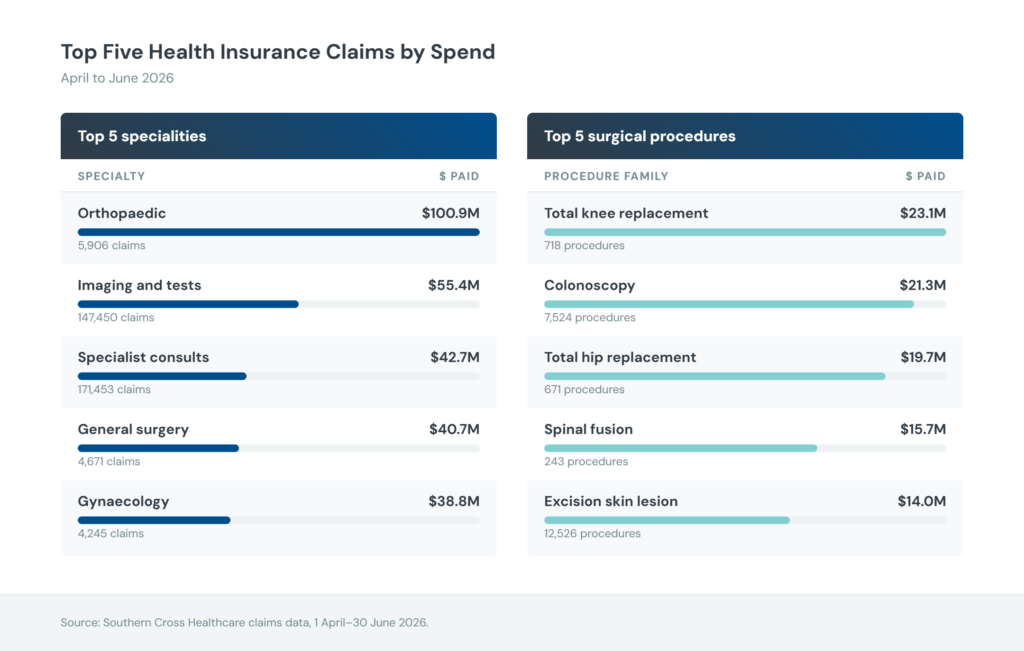
Southern Cross Healthcare data showed a similar pattern with orthopaedic procedures being the single biggest driver of claims spend in the April to June quarter, followed by imaging and tests, specialist consults, general surgery and gynaecology.
These figures line up with a public system still struggling to keep pace with demand. As of early 2025, over 74,000 people were waiting longer than four months for a first specialist assessment. While Health NZ’s most recent figures show wait times for elective treatments improving slightly, with 64.5% of patients now seen within the four-month target (up from 59.2% a year earlier), this is still well short of the government’s 95% goal and highlights why many people are turning to private health insurance.
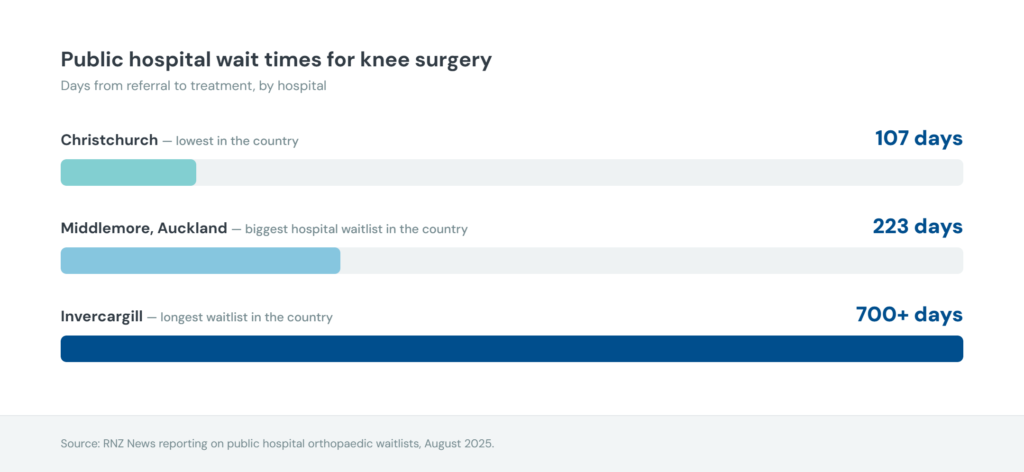
For example, looking at knee surgery (one the most common elective surgeries), wait times range from around 107 days in Christchurch (the lowest in the country) to 223 days at Auckland’s Middlemore hospital (the biggest hospital waitlist in the country), and over 700 days in Invercargill (the longest waitlist) (RNZ Aug. 2025).
The desire for faster access to healthcare is a pattern insurers across the market are seeing. AIA NZ’s chief customer officer recently pointed to more people seeking private diagnosis and treatment earlier specifically because of public wait times, wanting certainty rather than an uncertain queue.
The pressure on the public system is also showing up in the fact that many insurers are paying out more year on year to help policy holders get care sooner. AIA, which protects over 789,000 New Zealanders, accepted 91% of all claims received in 2025 and paid $177.31 million in health claims, with much of this going towards serious conditions like heart disease ($93.5 million) – a condition the New Zealand Heart Foundation says claims a life in New Zealand roughly every 90 minutes – and treatments such as chemotherapy and spinal procedures that can otherwise cost tens to hundreds of thousands of dollars.
Southern Cross paid a record $1.706 billion in claims in the year to June 2025, across 3.8 million individual claims, up 16% on the year before, and nib NZ saw a similar trend, with claims paid up 24% in the year to June 2025 as members made more use of their cover than ever, averaging just over two claims per policy, up from under two the year before.
And it’s not only major surgery with many policies also including cover for everyday healthcare as well as more significant procedures and operations. Imaging and diagnostic tests were the highest-volume claims category in Southern Cross’s latest quarter (147,450 tests, $55.4 million), and specialist consultations weren’t far behind this (171,453 visits, $42.7 million). Many health policies also include funding for non-Pharmac funded but Medsafe approved drugs, however cover differs significantly between insurers, ranging from $10,000 to $500,000 per annum so it pays to check what’s covered in your policy.
Data from insurers also shows the value of claims paid out doesn’t rise gradually with age, it compounds. Southern Cross figures show the average amount paid out per member roughly doubles between someone’s twenties and their fifties, then climbs again sharply from 65 onwards, while Partners Life’s Private Medical Cover claims peak earlier, at 40 to 49 ($21.0 million), before easing through the fifties ($18.2 million) and ticking back up from 60 ($18.7 million). The same pattern shows up across AIA’ NZs total claims experience too (covering life, health, trauma, income protection and disability claims together), with payments climbing steadily through the decades to peak at $221 million among customers aged 50 to 59, before easing to $147 million at 60 to 69.
For many, the earlier cover is in place, the fewer health issues have had the chance to become pre-existing conditions and be excluded. Waiting until health needs actually arise, in insurance terms, is usually the most expensive way to buy cover, both in what it costs and in what it won’t cover.
These figures are a timely reminder of some of the benefits health insurance can provide to allow you to get on with your life, including that:
If any of this raises questions about your own or your family’s cover, we are here to help. To book a time to speak with one of our specialist insurance advisers for a free review of your insurances, click here.
The content of this article should not be taken as financial advice, or a recommendation of any financial product. These insights are based on current economic commentary, market pricing for interest rates, and our personal opinion. Threefold is not liable or responsible for any information, omissions, or errors present.
Sources: Southern Cross Healthcare claims data, 1 April 2026 to 30 June 2026; AIA NZ Claims Compass (2025 results, released May 2026); New Zealand Heart Foundation; RNZ News reporting on public hospital orthopaedic waitlists (August 2025); nib NZ claims results (12 months to 30 June 2025); Aon 2026 Global Medical Trend Rates Report; Stats NZ Consumers Price Index, March 2026 quarter; Health NZ/Ministry of Health Target 2 factsheet, quarter ending March 2026, reporting December 2025 quarter performance (dpmc.govt.nz, published March 2026).