
AI tools have become part of everyday life, and it’s easy to see the appeal. Ask a question, get an instant, confident-sounding answer, no waiting, no appointment. So it’s no surprise that more people are turning to AI chatbots to ask for financial advice.
We use AI in our own business every day. We think it’s a genuinely useful tool for streamlining process, for research, for explaining concepts, and for helping you arrive at better questions to ask. But there’s a meaningful difference between using AI to get informed and using it to make a decision about your money, health or risk. When it comes to actual financial advice, a qualified human adviser still wins everyday of the week, and here’s why.
A chatbot only knows what you type into it, in that moment. It doesn’t know that your income is about to change because you’re starting a family, that you’re carrying a chunk of debt you’re quietly stressed about, the underlying health issues you’re keeping at bay (for now), or that your appetite for risk has shifted since the last time markets fell. A good adviser draws all of this out, often asking the questions you wouldn’t think to ask yourself, delving into the detail and building a picture that keeps evolving as your life does.
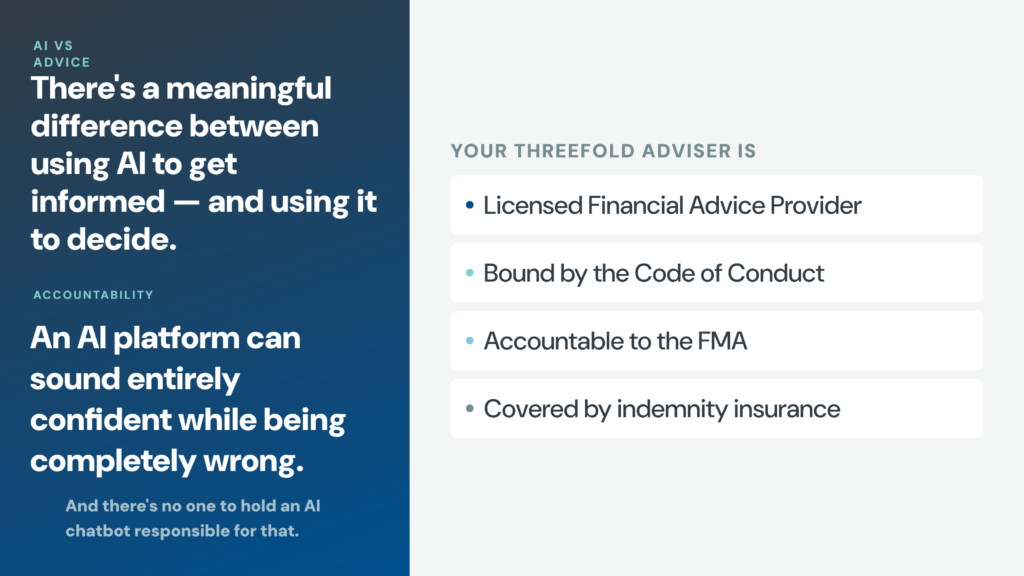
Our team at Threefold operate under a Financial Advice Provider licence, are bound by the Code of Conduct for Financial Advice Services, are individually accountable to the Financial Markets Authority, and carry professional indemnity insurance. If advice is wrong or unsuitable, there’s a clear complaints process and someone answerable for it. An AI chatbot carries none of that accountability. It can sound entirely confident while being completely wrong, and there’s no one to hold responsible when it is.
Some of the biggest financial decisions people make come during some of the hardest moments of their lives: after a redundancy, the loss of a partner, a health issue arising, a relationship ending, or a business sale that’s more emotional than it looks on paper. Or on the flipside, some of the most joyful: a pregnancy, finding the ‘perfect home’, a well-earned bonus or promotion coming through, or a marriage, In these moments, what people need isn’t just an answer, it’s a steady, experienced person who can read the room, understand the nuances, slow things down, drill into the detail and help you avoid a decision you’ll regret. That’s judgement, clarity and empathy, not pattern-matching.
Good financial advice isn’t a one-off transaction. It’s an ongoing relationship where your adviser checks in as your circumstances change, flags when your KiwiSaver fund or insurance cover no longer fits, supports you when it comes time to make a claim, and proactively reaches out when the market or the regulations shift in a way that affects you. A chatbot won’t call you when interest rates move, leverage its relationships with lenders and insurers on your behalf, identify a claim that you may not have known you were entitled to, or dig beneath the surface to make sure it has all the information required to help you make an informed decision. Your adviser will.
None of this means AI has no place. It’s a great starting point for understanding terminology, for getting a general sense of how something works, or for preparing questions ahead of a meeting with your adviser. Think of it as a useful research assistant, not a decision-maker. The moment a question becomes “what should I do” is the moment to bring in a qualified human.
If you’ve been leaning on Dr Google or an AI chatbot for financial or risk related questions lately, we’d love to have that conversation properly. Get in touch and book a free chat today – we’re here to help.
The content of this article should not be taken as financial advice, or a recommendation of any financial product. These insights are based on current economic commentary, market pricing for interest rates, and our personal opinion. Threefold is not liable or responsible for any information, omissions, or errors present.